Showing posts with label veterinarian. Show all posts

Monday, December 28, 2015

The Calf With the Broken Leg...Part 1...

Once upon a time, there was a newborn calf...

She was born three weeks early, so we weren't expecting her so soon.  One of the other animals in the pen inadvertently stepped on her newborn leg...

and it broke...

This is the first time we've had this happen in twenty-two years of farming, and we weren't sure what her prognosis would be.  We thought we'd have to put her down, but when Jim talked to the vet this morning, the vet was optimistic, so we decided to go ahead and have her little leg put in a cast.

The back leg nearest to you in this picture is the one that is broken...


We put her into a pen that was heavily bed up with clean, dry straw.  She was then sedated, and the vet began casting the leg...

If I tried to explain exactly why each step happened, I'd only be guessing, but I'll give you a brief explanation.

First, her leg was generously powdered...
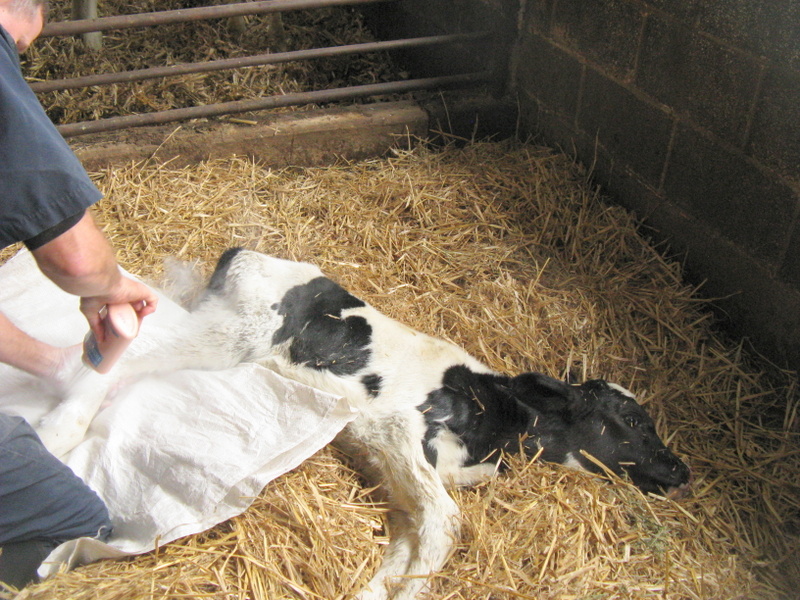

Next he put a long "sock" on her leg, from her hoof up to her "thigh"...


Next came the gauze, which helps protect the leg...


Then he wet the plaster...


Wrapped it and smoothed it...over and over again until it formed a thick cast...


The top and bottom of the "sock" were turned down and more plaster put over top...


Jim and I watched...and talked about the process and the prognosis...


All finished.  The plaster quickly hardened and dried...


She'll sleep for a while yet, and then the fun will begin, of teaching her to stand up with an awkward cast on her whole leg.  The break was in her lower leg, but the cast had to go the whole length of her leg in order to provide the stability necessary for healing.

Her cast will remain on for six weeks, and then hopefully she'll have healed completely.  Young, healthy calves typically heal well.

I'll keep you posted on her progress.  Hopefully it will have a happy ending!

Friday, February 22, 2013

When a Cow Needs Surgery...

How do you know if...and what do you do when...a cow needs surgery?

First of all, here is a short cow anatomy lesson...

Cows have four stomachs....the last one is called the Abomasum.  It normally lies below the rumen, but if for some reason the large rumen is smaller in size than usual, the abomasum can slip out of place and "float" up around the rumen, usually on the cow's left side.  It then gets trapped between the rumen and the wall of the cow's body.  This is called a LDA (left displaced abomasum)  This usually requires veterinary intervention to fix, but typically the cow makes a complete and quick recovery. Less often, it floats to the right (RDA), and this is much more serious.  In farmer lingo, we call this a twist, or a twisted stomach.

If you'd like to read a more detailed, and very easy-to-understand explanation, click here.

What are the symptoms of a twisted stomach?

The cow goes "off feed", usually only picking at some hay, and she might act depressed. Her manure may be "tight', a result of eating mostly hay and not eating her grain.

When does it happen?

Like several other conditions, it usually it happens soon after she freshens.  (you can read more at the link above)

How do we diagnose a twist?


Here, Jim is holding a stethoscope to the cow's side with his right hand, while flicking a finger of his left hand on her side.  If she's "twisted", he will hear a "ping", indicating gas in her displaced abomasum.

What do we do?

Different vets handle twists differently, but our vet operates by making an incision in her right side, putting the abomasum back into it's proper place and stitching it fast to the abdominal wall so that it cannot slip out of place again. We take the cow to the vet's facility where the fifteen minute operation is performed, and then we bring her back home again.


It's a little hard to see here, but how's that for a neat line of stitches?


This particular cow freshened on Saturday morning, had milk fever a day or so later, and twisted on Wednesday.  We do everything we can to keep them eating after calving...we keep lots of good quality dry hay in front of them...we introduce them very slowly to any different feed than they were getting as a dry cow...but sometimes it just happens.

She came back into the barn after surgery and began eating.  This makes us quite happy...to watch a surgery cow begin eating again, and now two days later, clean up everything we put in front of her!

Thankfully it doesn't happen often, but...just in case you ever wondered...

Linking up to Farm Girl Friday.


Monday, July 2, 2012

Doctoring Goats...

We had our first real experience with doctoring goats last week...and we really wish we hadn't had it!


Dilly meets Kitty
On Tuesday evening, Jenna came into the barn to tell us that her one goat, Dilly, wasn't eating, and was just laying down inside his hutch.  I went to investigate.  He would stand up and walk around, but then go right back into the corner and lay down.  His temperature was only slightly elevated, but he seemed uncomfortable...straining as if he needed to urinate, but wasn't able.


Light bulb!


We were taught about this at many goat meetings...the dreaded Urinary Calculi  (a fancy name for kidney stones)   Jim talked to the vet, who confirmed our suspicions just by asking a few questions.  He agreed to come to see what he could do for Dilly.

Here's the good news...

He sedated Dilly and was able to remove the  tiny stone which was blocking his urinary tract, offering the poor goat some relief!  He's been fine ever since...eating vigorously and yes, peeing as any goat would.  We celebrate every time we see it happen!  (it's the simple things!)

Here's the bad news...

This condition doesn't often have a happy ending.  Once a goat develops these Urinary Calculi, even with a successful procedure like the vet performed on Dilly, there are usually more stones that make their way down the urinary tract, causing more blockages.  If they can't urinate, their bladder can burst within 24-28 hours. 

Here's what we can do...


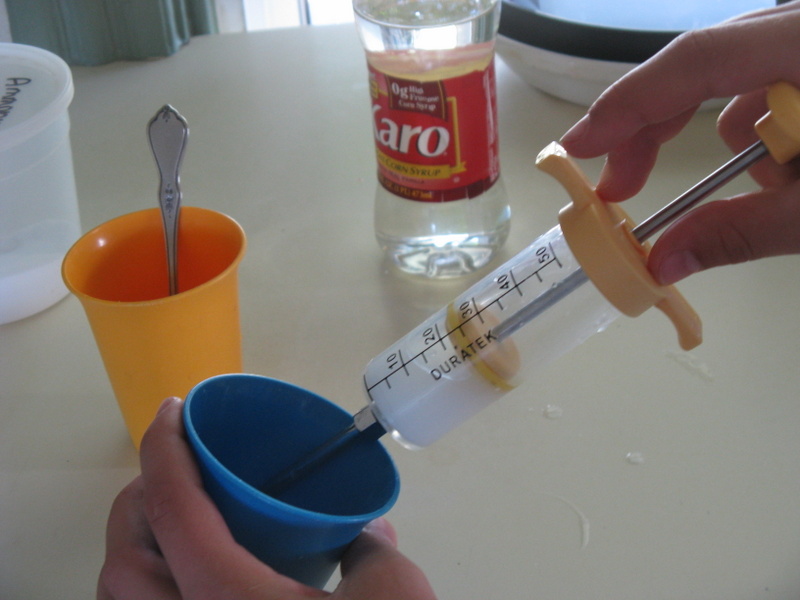
We got some Ammonium Chloride powder from the feed mill, mixed it with Karo syrup and a little water...


Pulled it up into the drench gun...


...and administered it to both goats every day for five days.  The purpose of this is to hopefully dissolve any more stones that Dilly may have, and also prevent Pickles from having the same problem...

Pickles in his favorite spot

Dilly

We really weren't expecting this to happen...we were feeding them a goat feed which already had Ammonium Chloride in it, for this very purpose...to prevent Urinary Calculi.  We were feeding them the recommended amount of grain, and the Phosphorus/Calcium ratios were correct.  We thought we were doing everything right.  However, for various reasons, it happened anyway. 


Young male goats that have been castrated at a young age are most susceptible.  Females rarely have this problem, because their urinary tracts are short, straight and wider in diameter.

Boer goats are also susceptible...perhaps because they are raised primarily for meat, and are often fed more grain to get them ready for market. 

We are thrilled that for now, Dilly seems to be doing just fine, and we are getting more attached to him every day. We won't know the end of the story until "who knows when"  He might get sick again, and we feel a little like we're sitting on pins and needles, just waiting.

But for now, we'll enjoy listening to him yell every time he sees someone who might give him food, watching him eat huge mouthfuls of weeds, and watching Pickles stand on his back to try to reach the leaves on the tree that are just out of reach!


Sunday, March 4, 2012

Stuff Happens...

It's interesting...

On most of the blogs that I read...not all, but most (mine included)...we tend to talk about the interesting, good, or fun things that happen, and shy away from the not so good.  I think that's normal...we don't want to talk about what goes wrong. 


I went back and forth on this one, and I must admit...I'm writing about this now that things are looking a bit better for this cow!


On Wednesday morning, as we milked down through the first two rows of cows, Jim suddenly noticed that "Mary" had tramped her one front teat.  Mary was fresh only a few days, and her udder was still swollen and cumbersome.  Apparently as she stood up, her sharp hoof caught on her teat and cut it badly.  This can be a death sentence for a cow...in fact it usually is!

We debated on what to do.  Jim milked her out as best he could, and called the vet.  Depending on the cut, the vet can stitch her teat. 

The vet came and took a look at her injury.  The sphincter muscle was intact, but barely. Had it been cut, she would have constantly leaked milk, and would have likely gotten mastitis, which would have given her a very grim prognosis.  (mastitis in a cow with an otherwise healthy udder is a totally different scenario than mastitis in a cow with this type of injury)

They decided that the best route to go was to trim away the damaged tissue and allow the wound to heal, rather than trying to stitch it back together.  The vet numbed her up, Jim held her tail, and I held the light.  (I don't do up close and personal bloody stuff very well, so I was hoping it would go ok, and it did!)  It was actually quite interesting to watch.  He cleaned her damaged teat thoroughly with iodine and alcohol, and got out his sterile tools.  He was pretty slick with that scalpel, and the cow didn't flinch!  

That was the easy part...


Now, we have to be diligent to see that her wound doesn't get infected, and that she doesn't get mastitis.  Jim milks her three good quarters with the milker...


Then he carefully cleans her teat with an alcohol pad...
 

 And inserts an individually wrapped teat infusion cannula into her teat...


The milk drains into a bucket.  She puts about 2 1/2 quarts of milk into the bucket each time, which we use for feeding calves.  The wound is healing nicely!  That's a scab you can see there.  If it continues to heal, her teat will be shaped a little funny, but that's a small price to pay!


Afterwards, Jim sprays her teat with this barrier spray to keep any dirt out of the wound...


As you can imagine, this can be time consuming and  challengingWhere there are cows, there is dirt and manure...it's just a fact of life.  No matter how hard we try, her udder will get dirty, so therein lies the biggest challenge...to keep that wound clean and free of infection.

So far, we have been very pleased with her progress.  She is a very cooperative animal, and we've seen no signs of infection.  Jim will soon try putting the milker on all four quarters, but not too soon, or it could pull the scab off and we'd be starting over from square one.


We're really hoping that this will be a success story!

Wednesday, April 20, 2011

Herd Check...

One of the things that is important to successful dairy farming is overall herd health management. 

We do a lot of diagnosing and treating of minor problems on our own...Jim gives medications  through injection, orally, or through IV when necessary...we do our own vaccinating, and he can usually diagnose things like a twisted stomach by listening to the cow's rumen with a stethoscope.

One valuable asset that we do use, however, is our veterinarian.  Jim can call him for advice, or have him come out to check on an animal when necessary...and one of the vets is always on call for after hours emergencies.

There are some things that we aren't able to do.. so we have a regularly scheduled "herd check".   During herd check, the vet will normally do pregnancy checks and "GYN" exams on cows.  It's also a great time to ask questions, stock up on meds or have him examine an animal that's not doing well.

Here, Jim is getting ready for herd check this morning.  He's checking the Herdex for cows that have been bred at least 40-42 days, which is when we choose to check them for pregnancy.  He will also have the vet check cows that have been fresh for over 60 days that haven't yet shown a heat.  The vet can tell if they are cycling normally or if they are "cystic" (have a cyst on their ovaries)


Below is the Herdex chart...Each cow has her own line on the chart.  The AI technician puts a green X on the date that she is bred.  When her green X reaches the second green line from the right, it has been 42 days since she's been bred.  If she is confirmed pregnant, the box is colored in solid purple.  It's a great way to keep records!


This is Dr. Ellis, the vet that we see most often on our farm.  He is checking this cow to see if she's cycling normally after freshening.  He does pregnancy checks in a similar fashion...he can feel the uterus with (hopefully) an embryo the size of a marble inside if she's pregnant. 


His truck is stocked with supplies and medications...if we need anything we get it from him before he leaves.

Then, when he's finished, he disinfects his boots and is on to the next farm.


This is just one more aspect of life on the farm...it takes working together to keep the animals healthy and the dairy running smoothly.


*Coming soon..."New Kids on the Block"...Jenna's 4 - H goats arrived today...it's already been an adventure!